Every moving company has a morning ritual. The owner stands with the day's jobs, the crews gather around, and the plan for the day gets handed out. Who takes which job, who takes which truck, who needs to be where at what time.
And most mornings, that is also when the problems show up.
Two jobs, one truck available. A quote that was sent but never followed up. A customer who called yesterday and was promised a callback that nobody wrote down. None of these problems were created that morning. They were created days or weeks earlier, in the gaps between the tools the company runs on. The morning briefing is just where they surface.
This article is about those gaps: where they come from, what they actually cost, and what changes when they are gone.
The six-tool setup
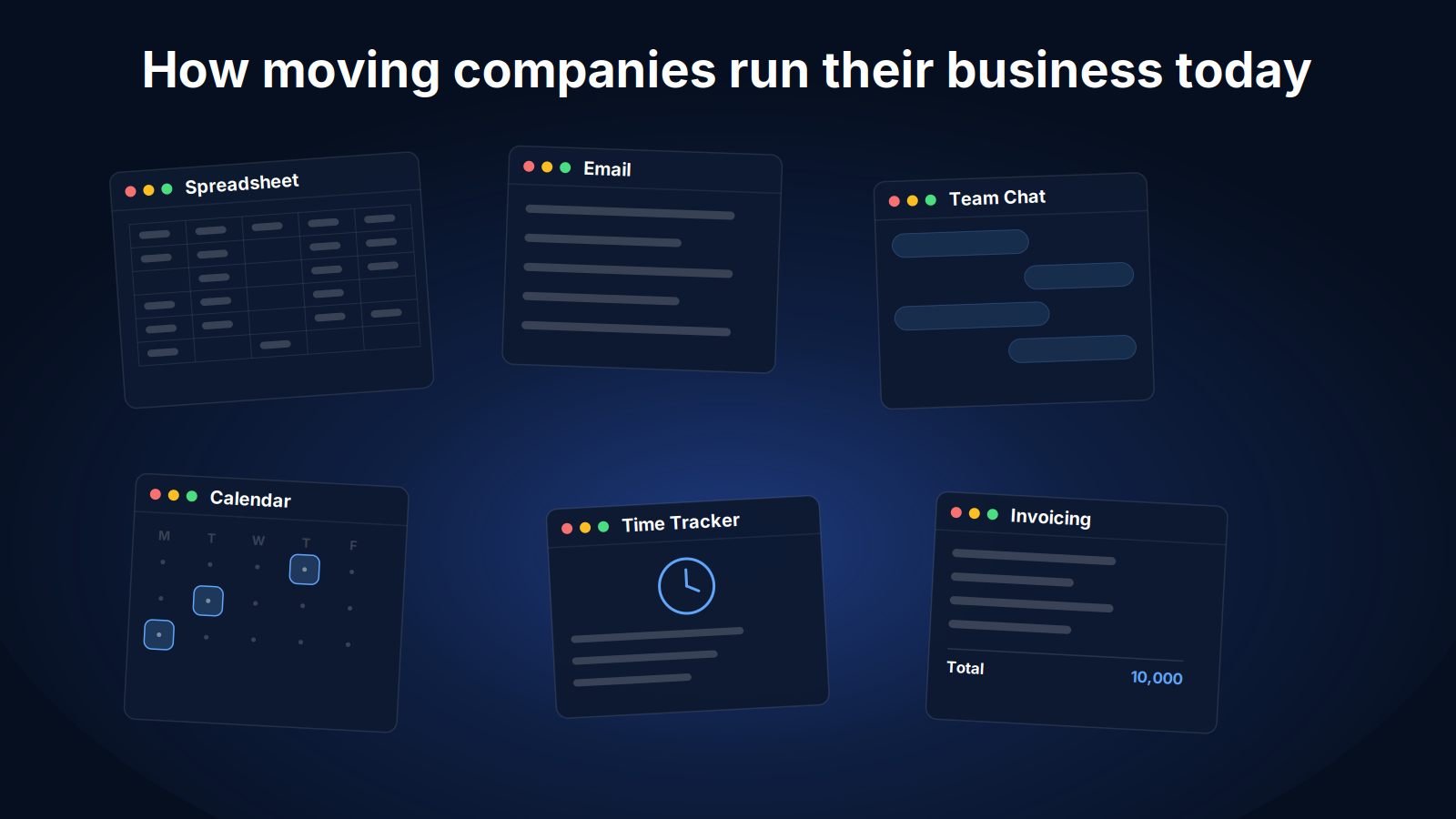
Walk into a typical moving company office and you will find some version of the same setup.
There is a spreadsheet where quotes are calculated. Cubic meters, distance, number of crew, hourly rates. It was built years ago by someone who may not even work there anymore, and by now nobody dares to touch the formulas.
There is an email inbox where customer communication lives. Requests come in, quotes go out, confirmations, changes, complaints. Somewhere in those threads is the answer to almost every question about every job, if you can find the right thread.
There is a chat app for the crew. Job addresses get pasted in, start times, gate codes, last-minute changes. It works, until someone scrolls past the message that mattered.
There is a calendar where jobs get planned. Sometimes digital, sometimes a whiteboard, sometimes both, and the two do not always agree.
There is a time tracking tool, or a stack of paper timesheets, where hours get written down so payroll can happen.
And there is an accounting tool where invoices get created, by typing in the same job details that already exist in the spreadsheet, the inbox, the calendar and the chat.
Six tools. Six places where a piece of the same job lives. And not one of them knows the others exist.
Nobody chose this
Here is the thing: no moving company ever sat down and decided that six disconnected systems was the right way to run the business.
It happened one tool at a time. The spreadsheet came first, because quoting by hand was slow. The chat group got created the day someone got tired of calling every crew member individually. The accounting tool arrived when the accountant demanded it. Each decision was sensible. Each tool solved a real problem on the day it was adopted.
The problem is what happened between the tools. Every new system added another place where job information lives, and another gap where it can get lost. The company did digitize. It just digitized into six pieces.
What the gaps actually cost
The costs of this setup rarely show up as one big visible number. They show up as small daily losses that everyone has learned to live with.
The retyping. Follow one job through the six tools and count the keystrokes. The customer's details get typed into the spreadsheet for the quote. Then into the email. Then the job goes into the calendar. Then the address gets pasted into the crew chat. Then the hours get written into the time tracker. Then everything gets typed one final time into the invoice. The same information, entered again and again by people who have better things to do. It is not just the minutes. Every retype is a chance to make a typo, and a typo in an address or a price is not a small mistake.
The slipped details. The expensive mistakes in a moving company are rarely dramatic. They are quiet. A quote that was sent and never followed up, so the job went to whoever answered faster. A callback that was promised and forgotten. An extra service the customer requested by email that never made it onto the invoice, so it was done for free. Each one is small. Across a year, they are not.
The 7 AM surprises. When vehicle planning lives in someone's head or a cell in a spreadsheet, conflicts stay invisible until the morning they happen. Two jobs, one truck, and now someone is calling around to rent a van at rental prices, on the company's busiest hour of the day. The conflict existed for two weeks. There was just nothing that could see it.
The single point of failure. In most moving companies, one person holds the whole picture in their head. Usually the owner. They know which quote is still open, which crew member is on vacation, which truck is due for service. As long as that person is present, sharp and never sick, the system works. That is a fragile way to run a company, and it is also why so many owners cannot take a real vacation.
The invisible business. Ask a simple question: how much revenue is on the board this month, and how many open quotes are waiting for an answer? In a six-tool setup, answering that means opening four programs and doing math. Most owners simply do not know, day to day. They find out when the accountant tells them, weeks after the moment when the number could have changed a decision.
What "one system" actually means
The alternative is not a seventh tool. It is one system where the whole flow lives, from the first inquiry to the paid invoice.
In practice, that changes a few specific things.
A job gets entered once. The inquiry comes in, becomes a quote, becomes a booked job, becomes a scheduled day with a crew and a truck, becomes hours, becomes an invoice. The information flows through, instead of being retyped at every step. The typo problem largely disappears, because there is nothing to retype.
The calendar knows what the quotes know. When a job is booked, it is on the schedule with everything attached: the customer, the address, the price, the crew, the vehicle. Nobody has to reconstruct a job from an email thread.
Vehicles stop double booking themselves. When every truck has its own calendar, an unavailable truck simply is not an option when planning a job. The 7 AM surprise gets caught at the moment of booking, weeks earlier, when fixing it costs nothing.
Follow-ups stop depending on memory. Open quotes are visible in one list, and the ones going stale stand out. The jobs that used to quietly die from silence get a phone call instead.
And the owner gets the picture back. Revenue this month, jobs on the board, quotes waiting, problems that need attention. One screen, current, without opening four programs. Decisions get made on today's numbers instead of last month's.
None of this is magic. Every single one of these things is just information being in one place instead of six.
The switching fear
The most common reason moving companies stay with the six-tool setup is not that it works. It is that switching sounds worse.
The fear is understandable. The current setup, for all its gaps, is known. Everyone has learned its workarounds. A new system means moving data, learning new screens, and a period where things feel slower before they feel faster.
But the honest comparison is not between switching costs and zero. It is between switching costs, paid once, and the gap costs, paid every single week forever. The retyping does not stop on its own. The slipped quotes do not follow themselves up. The truck conflicts do not start announcing themselves in advance. The six-tool setup has a subscription fee too. It is just paid in hours and lost jobs instead of a monthly invoice.
The companies that make the switch tend to discover the same thing: the hard part was smaller than feared, and the payoff was larger. Because the payoff is not one feature. It is the absence of a hundred small daily frictions that everyone had stopped noticing.
One system, built for this industry
This is the idea Movena is built on. One system for moving companies, covering the whole flow: leads, quotes, scheduling, crew, vehicles, hours and invoicing, all connected, so a job is entered once and lives in one place from first call to paid invoice.
Not a general tool bent to fit the moving industry, but a system built for how moving companies actually work, down to every truck having its own calendar.
If you want to know what the six-tool setup is costing your company specifically, we built a calculator for exactly that. Put in your own numbers and see: movena.io/en/savings-calculator
Setting a new standard for how moving companies operate.