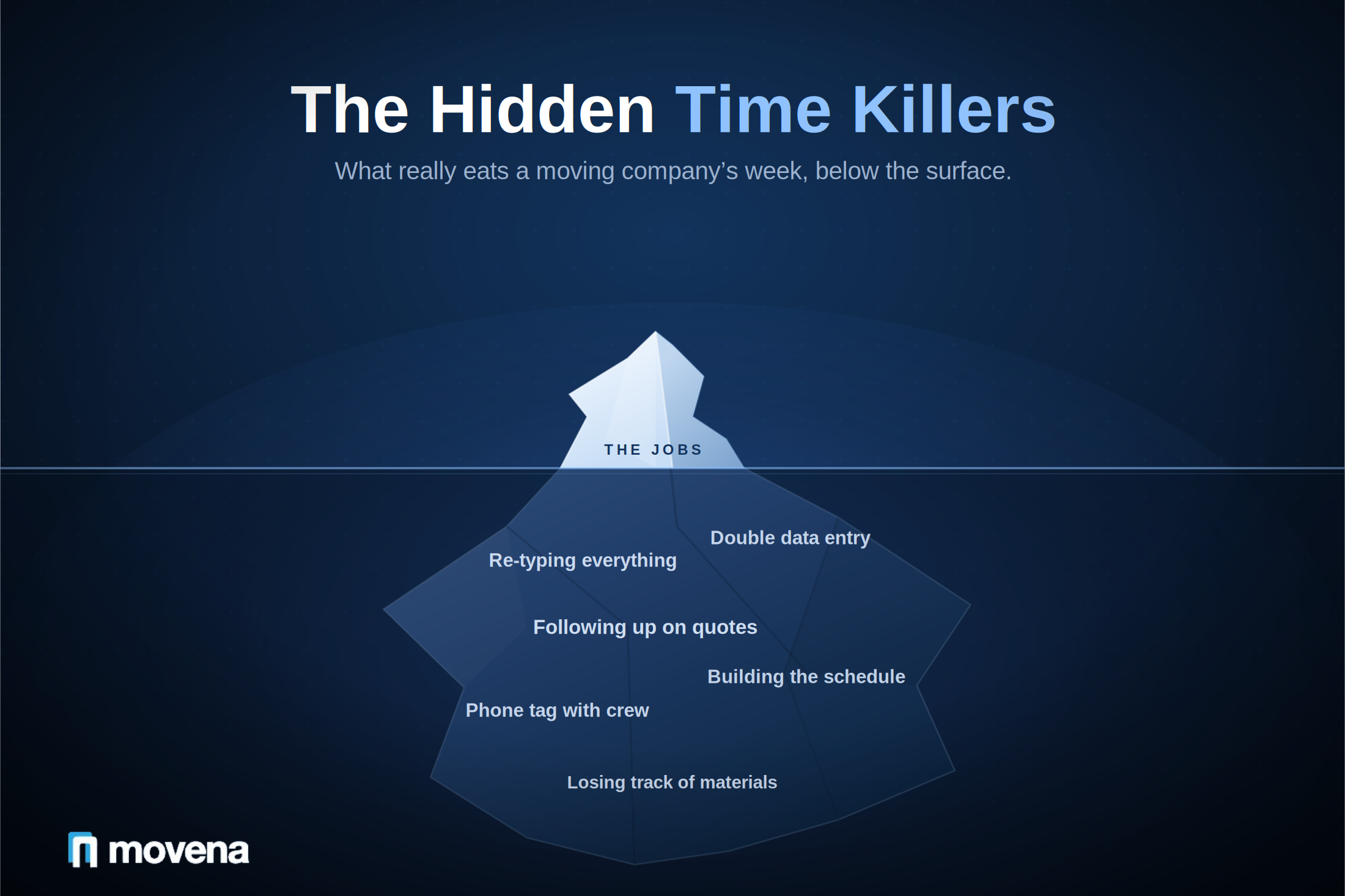
Ask a moving company owner where their time goes, and most will say the same thing. The jobs. The lifting, the driving, the long days on the road.
But the jobs are the part that works. The crew shows up, the truck gets loaded, the customer gets moved. That part has been figured out for decades.
The time that disappears is somewhere else. It hides in the gaps between the jobs. In the small tasks nobody plans for and nobody tracks. The five minutes here, the ten minutes there, the phone call that should have taken one minute and took fifteen.
None of it feels like a problem on its own. That is exactly why it is one. A task that takes five minutes does not get your attention. A task that takes five minutes forty times a week does, but by then it is buried so deep in the routine that you stop seeing it at all.
This is a look at where those hours actually go. Not the obvious costs. The hidden ones.
The week that looks full but isn't
Here is something worth doing before you read the rest. Think back over your last working week and try to account for it hour by hour.
You will find the jobs easily. You know exactly when the crew was out and where. But there will be a gap. A few hours, maybe more, that you cannot quite place. You were busy the whole time. You did not stop. And yet you cannot point to what you produced in that window.
That gap is not laziness and it is not bad luck. It is the sum of the small tasks below. Each one is invisible on its own. Together they are one of the biggest costs in the business, and it never shows up on any invoice.
Re-typing everything
A customer calls. You take down their name, their address, the date, what they are moving. You write it somewhere. A notebook, an email to yourself, a message in your phone.
Then the job gets confirmed, and you write it again, this time into whatever you use to plan the week. Then it goes on the calendar, so you write it a third time. Then the job is done and it needs invoicing, so the name and the address and the price get typed one more time.
The same handful of facts, entered by hand, over and over. Each time takes a minute or two. Each time is a chance to get a digit wrong.
One customer is nothing. Now multiply it by every job in a busy week. The typing alone is an hour gone. The mistakes cost more, because a wrong address or a wrong price does not stay a small problem for long.
Double data entry
This one is close to the first, but it deserves its own line, because it is the tax you pay for using more than one tool.
You run the job in one place and invoice it in another. The two do not talk. So every job has to be entered twice, once where you plan it and once where you bill it. When something changes in one, you have to remember to change it in the other. When you forget, the two versions drift apart, and now you are not sure which one is right.
Keeping two systems in sync by hand is pure overhead. It produces nothing. It exists only because the tools were never connected, and someone has to be the bridge between them. That someone is usually you.
Following up on quotes
You send a quote. The customer says they will think about it. Then nothing.
A week later you half remember that you never heard back. Was it the family moving across town, or the office job? You dig through your sent folder to find it. You are not sure if you already followed up or not, so you either risk sounding pushy or you let it sit.
Multiply that uncertainty across every open quote you have. The mental effort of holding all of it in your head, of trying to remember who is waiting on what, is a tax you pay all day even when you are not doing anything about it.
And the quotes you forget to chase are not small losses. Those are customers who already wanted to move and already got a price from you. The work of winning them was done. They slipped away in the gap between the quote and the follow-up, and you will never see it on a report, because a job that never happened leaves no trace.
Building the schedule
Who is working tomorrow. Which truck. Which jobs, in what order, with enough time to get between them. Does the big job have enough people. Is anyone double booked.
For a lot of moving companies this gets solved fresh every single day, in someone's head or on a whiteboard, by holding all the moving parts at once and hoping nothing was missed.
It is skilled work and it is genuinely hard. It is also the kind of work that has to be redone the moment anything changes, and something always changes. A cancellation, a sick crew member, a job that runs long. Each change means going back to the start and reworking the whole day.
The hours spent planning are real, but the bigger cost is the fragility. A plan that lives in one person's head is a plan that breaks the day that person is unreachable.
Phone tag with the crew
The job tomorrow changed. The start time moved, or the address was updated, or the customer added a piano.
So you call the crew. No answer. You text. You wait. They call back while you are on another line. You miss it. You call again. By the time everyone actually knows the new plan, you have spent twenty minutes on something that was one small change.
Now do that for every change on every job, and remember that jobs change constantly. A moving company's week is a stream of small updates, and every update that has to travel by phone is a handful of minutes and a chance for someone to end up at the wrong place at the wrong time.
The cost is not only your time. It is the morning a crew shows up expecting one thing and finds another, because the update reached four of them and not the fifth.
Losing track of materials
How many boxes are left in the warehouse. How much tape, how much wrap, how many blankets. Which materials went out on which job, and which ones came back. Not tracked box by box, just never really under control.
For most moving companies this is a guess. The materials go out, some come back, some do not, and nobody writes any of it down. So when you need to know what you have, you go and count. Or you order more to be safe and end up with too much. Or you run short in the middle of a busy week and someone has to make an emergency run.
None of that is moving furniture. It is time spent chasing supplies that should simply be known. And the margin leaks quietly here too, because materials that walk off the books are materials you paid for and never charged for.
Adding it up
Take these six honestly and put rough numbers on them for a normal busy week. The repeated typing. The two tools kept in sync by hand. The chasing and remembering of quotes. The daily rebuild of the schedule. The phone tag. The counting of materials.
For most moving companies this is not minutes. It is hours. Often the better part of a day, sometimes more, spread so thinly across the week that it never announces itself.
That is a whole working day, or close to it, that produced no moves, won no new business, and improved nothing. It was spent keeping the existing work from falling apart.
And here is the part that stings. Nearly all of it is the same kind of problem wearing different clothes.
Why it happens
Look back at the six. The typing, the syncing, the chasing, the planning, the phone tag, the counting. They share a single root cause.
The information about a job does not live in one place. It lives in many. A little in email, a little in a notebook, a little in an accounting tool, a little in your head. And because it lives in many places, work has to constantly move between them by hand, and you are the one moving it.
Every one of these time killers is really a symptom of the same thing. When the job, the schedule, the crew, the materials, the quote, and the invoice are all separate, someone has to keep stitching them together all day long. That stitching is the hidden work. That is where your day goes.
It is not a discipline problem. You cannot organise your way out of it with more effort or a better notebook, because the effort is the cost. The more carefully you hold all the pieces together by hand, the more of your week you spend holding them.
What to do about it
Start by seeing it. For one week, notice the small tasks. Every time you type something you already typed, every time you go looking for something, every time you play phone tag, make a mark. You do not need to be precise. You just need to stop the tasks from being invisible, because a cost you can see is a cost you can decide to cut.
Then ask a simple question of each one. Does this task create anything, or does it only exist because the information lives in two places instead of one? Most of the six above will fall on the wrong side of that line.
The tasks that only exist because of scattered information are the ones to attack, and there is really only one way to attack them at the root. Bring the pieces into one place. When the quote, the job, the schedule, the crew, the materials, and the invoice all live in the same system, the stitching stops being your job. The information moves itself. The quote becomes the job. The job carries into the schedule. What happened on the job flows into the invoice. Nobody types it twice, because it was only ever entered once.
This is the reason we built Movena. Not to give moving companies another tool to check, but to close the gaps the other tools leave open, so the hidden hours go back to being real ones.
You will not win them all back. Some of that time was always going to be spent. But if even half of the hidden day comes back to you, that is half a day a week to sell, to plan, to be out with the crew, or simply to not be the person everything runs through.
The jobs were never the problem. The gaps between them were. And gaps, unlike jobs, can be closed.