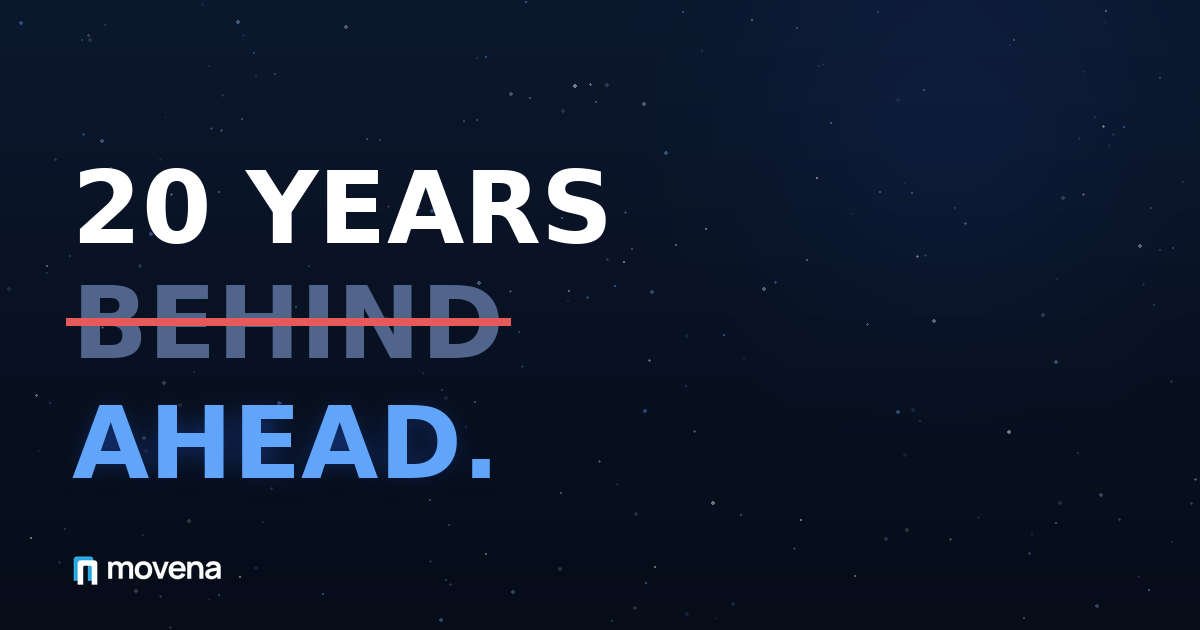
The moving industry is twenty years behind. That is exactly why it is worth building for.
Walk into most moving companies and you will find something that has not really changed in decades. A whiteboard on the wall. A shared inbox nobody fully trusts. A stack of paper quotes. A spreadsheet that one person understands and everyone else is afraid to touch.
It is easy to look at that and think the industry is broken. It is not. It is just stuck. And stuck is a very different thing from broken. Broken means it does not work. Stuck means it works, but on tools that stopped improving a long time ago, while the rest of the world moved on without it.
That gap is the whole opportunity. Let me explain why.
Every other industry already had its turn
Think about what happened to the businesses around you over the last twenty years.
Restaurants got online ordering, table management, and kitchen display systems. Taxis became apps. Hotels run on booking platforms that did not exist when most of their buildings were built. Even the corner shop has a point of sale system that tracks stock and sales in real time. Hairdressers book appointments through software. Accountants stopped doing everything by hand.
One industry after another got its own modern toolset. Software showed up, fit itself to how that specific business actually worked, and quietly became the thing everyone runs on. Nobody thinks about it anymore. It is just there.
Moving companies mostly skipped that wave.
Not because the people running them are behind. They are some of the most practical, hard working operators you will ever meet. They skipped it because nobody built the tools for them. The software industry chased bigger, flashier markets. Moving was seen as too physical, too fragmented, too old fashioned to bother with. So the tools never came, and moving companies did what they have always done. They made it work with what they had.
What "twenty years behind" actually looks like
It is worth being specific, because the gap is not abstract. It shows up in the same places every single day.
A customer asks for a quote. Someone works it out from memory or a rough formula in a spreadsheet, types it into an email, and sends it. Then it disappears into an inbox and nobody follows up, because there is no system reminding anyone to.
A job gets booked. It goes on a whiteboard, or into a calendar that lives in one person's head. Two jobs land on the same Saturday and nobody notices until the morning of, when there are not enough people to cover both.
The crew shows up. The paperwork is not ready. The address is wrong. Half the equipment is out on another job that has not come back. So the day starts with waiting instead of working.
The job finishes. The invoice waits for someone to get around to it. Some invoices go out late. A few never go out at all, because in the chaos nobody remembered.
None of this is anyone's fault. It is what happens when a real, complex business is run on tools that were never designed for it. A spreadsheet is a brilliant invention. It was just never meant to run a moving company.
Why being behind is good news, not bad
Here is the part most people get wrong. They look at an industry running on whiteboards and paper and they see a problem. What they should see is room.
When an industry is twenty years behind, it means twenty years of improvements are sitting there, already invented, already proven in other industries, just waiting to be applied. You do not have to invent anything new. You have to bring what already works everywhere else to a place that never got it.
That is a much easier and much more valuable thing to do than people think.
Compare it to an industry that is already modern. If you wanted to build software for, say, online retailers today, you would be the thousandth company to try. Everything has been done. The tools are excellent. The margins for improvement are tiny. You would be fighting for scraps.
Moving is the opposite. The baseline is so low that even getting the basics right feels like magic to the person using it. Show a moving company owner a system where the quote, the booking, the crew, the truck, and the invoice all live in one place and talk to each other, and you are not offering them a small improvement. You are offering them something they have genuinely never had.
The trap of building the wrong thing
There is a catch, and it is the reason most attempts at this fail.
When people finally do build software for an overlooked industry, they usually build it wrong. They build what they think the industry needs, from the outside, sitting at a desk far away from the actual work. They add features that look impressive in a demo and mean nothing on a Tuesday morning when a crew is standing in someone's driveway.
The moving industry has seen this before. A few tools exist. Most of them solve one narrow slice of the problem. A standalone quoting tool here. A route planner there. Each one is another login, another thing that does not talk to the others, another island. So the company ends up with five tools that do not connect, which is sometimes worse than the spreadsheet they started with.
The reason this keeps happening is simple. The people building the tools do not understand the work. They have never quoted a five bedroom house. They have never had a crew call in sick at 6am. They have never chased an invoice that went out three months late. So they build for the version of the business that exists in their head, not the one that exists in real life.
The only way to get it right
If being twenty years behind is the opportunity, then understanding the work is the key that unlocks it.
The companies that will actually fix this industry are the ones that build with moving companies, not at them. That means sitting with the people doing the work. Watching how a quote actually gets made. Seeing what the morning really looks like. Asking what the most annoying part of the day is, and then building exactly that, instead of whatever looked good in a pitch deck.
It is slower. It is less glamorous. You cannot do it from a distance. But it is the only way to build something that fits a real business instead of fighting it.
This is the whole reason the gap has stayed open for so long. Closing it does not require a genius idea. It requires patience, and a willingness to learn an industry that most of the tech world decided was beneath them. The ones who are willing to do that get a market that has been waiting twenty years for someone to take it seriously.
What happens when the gap finally closes
Picture a moving company a few years from now, running on tools built properly for it.
A lead comes in and lands in one place automatically. A quote goes out in minutes, accurate, based on real numbers instead of a guess. It follows up on its own if the customer goes quiet. The job gets booked straight into a shared calendar that makes double bookings almost impossible. The crew and the truck get assigned in seconds. Everyone knows where the equipment is. The job finishes and the invoice is one click away, straight into the accounting.
None of that is futuristic. Every piece of it already exists in other industries. It is just being brought, finally, to one that got skipped.
When that happens, the companies who adopted it early will not just be a little more efficient. They will be playing a completely different game than the ones still running on whiteboards. They will quote faster, lose fewer jobs, waste less time, and keep more of the money they earn. The gap that held the whole industry back becomes the edge that a few companies pull ahead with.
The bottom line
An industry being twenty years behind is not a sign that it is hopeless. It is a sign that nobody has done the work yet. The demand was always there. The businesses were always there, run by people who deserve better tools. What was missing was someone willing to actually understand the work and build for it properly.
That is not a problem. That is the opportunity of a generation, hiding in plain sight, in an industry everyone else walked past.
We think moving companies have waited long enough. So we are building it the only way it works. With them, not at them. One real conversation, one real job, one real fix at a time.
Setting a new standard for how moving companies operate.